 Italiano
BUILDINGS AROUND THE VILLA AND GARDENS
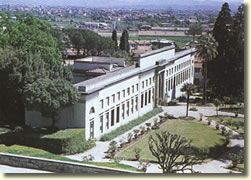 Adjacent to the Villa are several buildings, such as the chapel (home to the Pietà with Saints Cosmas and Damian, painted in 1560 by Giorgio Vasari), the kitchens (of which the first iconographic traces date from some plans of 1610), and the neoclassical plant house (or lemon house or "limonaia") "with an adjoining water cistern", a work by Poccianti (around 1825). Around the mid-16th century, under Cosimo I, Niccolò Tribolo redesigned the gardens and completed construction of the stables around 1548. The overall view of the layout of the garden and stables after Tribolo's work can be seen in the famous lunette by Giusto Utens of 1599. The stables, purchased by the Municipality of Poggio a Caiano at the end of the 1970s, stand just outside the Villa's boundary wall, along the road to Prato. Of great interest are the gardens surrounding the Villa, redesigned after 1811, though not entirely following the original plan drawn up by the engineer Giuseppe Manetti, commissioned by Elisa Baciocchi. That plan envisaged transforming them into an English-style garden, with the creation of a small lake and a temple dedicated to Diana, together with further landscaping interventions. Today only the part of the gardens extending beyond the rear façade of the Villa, towards the Ombrone, appears as an English-style garden, with shaded avenues and characterful corners. On the right-hand side of the Villa, the gardens have instead kept the appearance of an Italian-style garden, with a central pool and numerous pots of lemon trees.
 Here the garden is enclosed on three sides and closed on the fourth by the aforementioned Poccianti building. The gardens are enriched by rare plant species and by several statues, such as the terracotta one depicting the capture of the nymph Ambra by Ombrone, as described by Lorenzo de' Medici in his poem Ambra.